What If Gordon Banks Had Played, Part 5
8th April 1975
The Head of Special Branch, Deputy Assistant Commissioner Victor Gilbert, sat uncomfortably in the Home Secretary's Office as William Whitelaw shuffled through his papers. “Much appreciated, you coming out like this,” Whitelaw said as he settled into his seat. “Now, this Angry Brigade business.”
“Is our number one priority sir. As you know, we have had three more firebombings on Conservative Party offices over the last month.” Whitelaw perched his reading glasses on the end of his nose and peered at his briefing papers as DAC Gilbert spoke. “Followed by the firebombing of Mr Clark's London flat yesterday.” Alan Clark, the Parliamentary Private secretary to Julian Amery had returned to his London pad last night to find it gutted.
“He's very upset I understand. A lot of the Government are being concerned for their safety.”
“We have as yet received no intelligence suggesting that Minister's themselves could become targets. The communications received from the bombers have all suggested that they are only targeting property.”
“That is all well and good, until they firebomb a house that has someone's wife and children inside.” Whitelaw paused. “So, what progress have you made in tracking them down?”
“We have some leads, but nothing concrete yet. The problem that is facing us is that the anarchists are acting under the cover of the strikers. We have hundreds of striking miners, power workers and what not parading the streets and picketing Government building and perhaps a handful of anarchists hidden amongst them. Obviously, if the Unions do go ahead with their general strike the situation will only get worse.”
“I quite understand,” the Home Secretary said comfortingly. “This is a top priority though for the Prime Minister. He wants the culprits tracked down and he wants it done quickly. Just see if you can shake it up a bit, Victor, try and get a quick result. There's a good chap.”
Deputy Assistant Commissioner Gilbert forced a weak smile and look his leave.
Address by the Prime Minister, the Rt Hon J. Enoch Powell MP, broadcast on ITV and BBC1 on the 14 April 1975
"Earlier this morning the leaders of several trade unions announced there intention to try and bring down the democratically elected Government of the United Kingdom. When I stood before this nation last June, I laid out the policies that a Conservative Government would pursue. You, the British public, were generous enough to place your trust in the Conservative Party to fulfil that task. By attacking the Government, the unions are not just attacking politicians; they are attacking democracy and, by extension, attacking the voters.
"I do not deny that trade unions have a place, I do not dispute that man should be allowed to stand alongside his fellow man when negotiating with his employer. The United Kingdom though, is a democracy and Parliament must remain sovereign. The Industrial Relations Act has been passed by Parliament. We cannot pick and choose which laws we obey. If one finds a law offensive or wrong the way to protest is through the ballot box. One cannot try to blackmail the Government into changing the laws to line the pockets or build the egos of small minority for, and you can be sure of this, if the Government were to back down now the unions would not be satisfied or sated. They would return, with greater and more costly demands. More power. More money. More greed.
"We recall the lessons of the Wilson Government. Years of scraping and saving to feed the ever growing cuckoo of the unions, and their demands for more rights, more powers, more of taxpayers money. When this Government was elected it marked a break with that past. No longer will the Government bow to those who do not respect our democratic traditions, those who seek to use blackmail to change policy. The trade unions movement is no longer a benevolent creature, working for the common man, it is become a cancer, eating at our democracy and one that it is our duty to oppose.
“Twelve unions, including the coal miners, announced their intention to strike this morning. The Government has prepared for this and is prepared to stand up to it. There are stock piles of coal and oil available at power stations. A state of emergency has been declared and I have today asked the Secretary of State for Defence, Mr Amery, to prepare British troops to carry out essential work and to break up illegal picket lines so as to allow those who wish to continue to work to go about their daily lives unmolested. The Government will do all it can to maintain essential services during this period. I call upon all British people, all who support our Parliament and our democracy to resist this action, to remain calm and to go about your lives as normal.”
Letter received by the Daily Express, 15 April 1975.
Communique 8
You think you can crush us, but you're wrong. We will not remain silent in the face of this onslaught — we are fighting back. So far our actions have been aimed at property and not people, but our patience is wearing thin. WE ARE GETTING CLOSER.
Communique 8
The Angry Brigade
From “Diaries” by Alan Clark (Phoenix, 1997)

18th April — London
Still stuck in London. Every petrol station seems to have two hour long queues and with the flat gutted I am stuck in this foul hotel. Willie Whitelaw lead on the Immigration and Repatriation Bill in the Commons today and Roy Jenkins looks as though he was on the verge of a heart attack, swelling and pompous and scarlet. Heath criticised as usual. No idea why the damn fool doesn't just join the Labour party. Central lobby was full of dockers lobbying over the bill. Bizarre to have people actually turning up in support of us. Hopefully it will rub off on some of the miners.
9pm
Evacuated from the Commons. There is apparently a car bomb parked in the House of Lords car park. The policemen walk down all the corridors ushering us out and everyone ends up stood shivering in Parliament Square. It's absurd of course. It's the bloody Lords car park for a start — if the thing exploded it would hardly damage the other end of the building. I go to JA's house in Lord North Street and skulk.
From the Sunday Telegraph, 27 April 1975
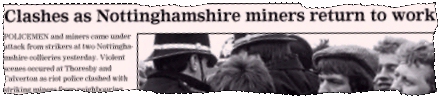
Policemen and miners came under attack from strikers at two Nottinghamshire collieries yesterday. Violent scenes occurred at Thoresby and Calverton as riot police clashed with striking miners from neighbouring counties, seeking to prevent miners returning to work. 7 policemen were injured, one seriously, and 34 arrests were made.
The violence follows the announcement on Friday that Miners in Nottinghamshire would return to work. This followed the Dockers' Union announcement that their workers were “backing Enoch, as a man prepared to stand up for the honest, white, working class Englishman.” It is reported that there are other pro-Government factions in the unions who are considering breaking the strike.
In a statement to Parliament on Monday afternoon the Defence Secretary, Julian Amery, is expected to announce that troops will be used to protect Nottinghamshire collieries...
Panorama, 28 April 1975
[transcript]
Robin Day: Today we have seen two miners and one soldier killed in violence in Nottinghamshire. Do you still think the Government's actions are justified?
James Prior: Well, obviously the deaths are very regrettable.
RD: Of course they are, Mr Prior. We want to know whether, in the light of three deaths you consider the Government's actions to be misguided?
JP: Well, with the benefit of hindsight...
RD: You think the Government made the wrong decision? Provoking a confrontation?
JP: Perhaps if one had one's time again we would all do some things differently.
RD: You do believe that this Government — that you are part of — acted wrongly?
JP: Well I...
RD: Will you be resigning Mr Prior?
From “An Unhappy Juncture: The Powell Government” by Anthony Selsdon (Harpercollins, 1988)
Prior's resignation came as a boost to the unions. Earlier in the week support had been dripping away from the unions as working men who cared more about the contentious issue of immigration than the legal technicalities of the Industrial Relations act came down on the side of “our Enoch”. Prior's resignation however gave the unions a scalp, and gave the strike new impetus. It seemed on the morning of the 30th April that victory was close for the unions and those strikers who had been wavering in fear of a long dispute without wage or benefit to support their families were given new hope. One Government minister had resigned, unemployment was rocketing and an unpopular government was trailing badly in the polls — they would have to back down. The events of the 1st May would change that, and the trade union movement would never forgive the tabloid press for what they saw as the great betrayal.
The traditional May Day parade was to have been a centre-point of the strike. Tens of thousands of trade unions descended upon London, and security was at the highest level. All police leave was cancelled and police authorities in London expected the normally peaceful march to descend into violence. Careful contingency plans were in place to try and keep any violent demonstrations away from Whitehall, however the fact was that the police could not realistically stop a peaceful march from passing down Whitehall into Parliament Square.
The subsequent public enquiry eventually cleared the organiser of the march of any complicity with the events of the afternoon, the court of public opinion would not be so generous. The exact events are still disputed, and the eight members of the Angry Brigade who were eventually prosecuted all but one have refused to pass comment, however it is likely that at least four were present in the demonstration. Whether any or all of them were actually trade union members is, once again, a mystery; the tabloids assumed they were.
The facts are that the demonstration erupted into violence around Trafalgar Square and police acted to contain the rioters within the square, blocking the exits and containing the riots within the square itself. The main body of the demonstration continued down Whitehall in a peaceful fashion. A cabinet committee meeting had been scheduled for eleven o'clock and the initial police plan had been to secure the demonstrators further up Whitehall until Powell and the other Ministers had finished the meeting and departed from Downing Street. In an attempt to move the peaceful demonstrators away from the riots and contain them within Parliament Square they were moved down Whitehall, however upon reaching Downing Street parts of the demonstration refused to be moved and, according to police witness at the inquiry, the situation seemed ready to turn violent.
At this point the Secretary of State, Julian Amery, arrived for the cabinet committee meeting in his ministerial car. As the car pulled up outside Downing Street the crowd, possibly believing the car contained Powell, surged forward into Downing Street (which, despite suggestions floated in 1973 was not gated until 1976). The riot police stationed in Downing Street itself deployed themselves across the street and armed policemen issued verbal warnings for the crowd to retreat as Julian Amery was rushed into the building. At this point, according to the findings of the official inquiry, one of the four conspirators (the identity of the gunman has never been proven) opened fire on Amery, hitting him with three bullets, and killing him instantly. Almost simultaneously the armed police officers loosed two warning shots over the heads of the protesters.
The protesters broke and fled at the sound of gunfire, pursued by riot police, the violence was put down after several mounted baton charges, which left 57 protesters injured. 45 arrests were eventually made, including the four Angry Brigade conspirators. Four further conspirators were arrested two days later. The weapon used to shoot Amery was found at the scene.
It is worth noting that the only one of the Angry Brigade to speak publicly about the incident, John Barker, admits his involvement in the bombing campaign but maintains that the Angry Brigade limited their targets to property, not people, and blames the assassination of Amery on a Government stitch-up, aimed at discrediting both the Angry Brigade and the Trade Unions. There are still several unanswered questions over Amery's shooting and it has remained fertile ground for conspiracy theorists.
The Public Inquiry later found that the trade unions and the organisers of the demonstration had played no part in the shooting. However the immediate reaction of the newspapers, most obviously the Conservative tabloid press, was to blame the strikers. The next days newspapers said simply that Amery had been assassinated by rioting strikers and highlighted the supposed trade unions links of three of the alleged assassins. The “Angry Brigade” went almost unmentioned.
Amery's assassination eliminated support for the strike almost immediately. By noon the next day the strike had been suspended pending talks with the Government, within a week it was over. The new Secretary of State for Industry, Geoffrey Howe, had made some minor concessions, including returning the right to claim benefits to the families of striking workers and a promise of at least a pay rise in line with inflation next year. Overall however, it was a major victory for the Government. One could almost be forgiven for believing the conspiracy theorists.