What If Gordon Banks Had Played, Part 3
“When faced with the same old problems I reached for the same old solutions.” — Harold Wilson
From the Daily Telegraph, 2nd June 1972

The House of Lords rejected the European Communities Bill for a second time last night. The Bill will ratify the Treaty of Rome, signed earlier this year, and is necessary before Britain can formally enter the EEC. Conservative peers, many of whom had turned out specially for the vote, overwhelmingly rejected the Bill, although there was also widespread opposition from the crossbenches. The Prime Minister, Mr Harold Wilson, has made it clear that he is willing to do all that is necessary to push the Bill through the House of Lords and last night announced the creation of ten new Lords as what Downing Street sources describe as “a shot across the bows”. The implication of Mr Wilson's action is that he is willing to create as many peers as are necessary in order to pass the legislation, however, this is seen as very much the nuclear option and most observers believe that if the House of Lords do reject the Bill once again Mr Wilson is more likely to use the provisions of the Parliament Act to overrule the House of Lord's objections.
The new peers appointed by Mr Wilson are:
- Mr Michael Young — pioneer of the Consumer's Association and the Open University and former secretary to the Labour Party Research Department
- Mr Peter Davis — journalist and media advisor to Mr Gaitskell and Mr Wilson.
- Mrs Marcia Williams — private secretary to the Prime Minister.
- Mr Robert Maxwell — publisher and former Labour MP for Buckingham
- Mr Victor Mishcon — solicitor
- Sir Eric Fletcher — former Labour MP and Deputy Speaker of the Commons
- Mr John Harris — a journalist for the Economist magazine and former special advisor to several Labour ministers
- Mr Arthur Woodburn — former Labour MP and Secretary of State for Scotland
- Mr Sidney Greene CBE — general secretary of the National Union of Railwaymen
- Mr Donald Chapman — Former Labour MP and chair of the Commons Procedural Committee
From the Leader of the House of Commons

4th June 1972
Dear Harold,
Having served in your cabinet for five years, I now feel that my position has become untenable and have decided to offer my resignation.
You know well, from our many discussions around the cabinet table, that I have deep reservations over your decision to join the EEC. I have in recent years restrained myself from commenting publicly in the interest of party unity and collective responsibility. However, your decision to bulldozer through the European Communities Bill by using the Parliament Act is a step to far, and a step that I cannot publicly support. The Parliament Act was never intended for major constitutional legislation. Across Britain there is deep concern and opposition to British entry into the EEC and I no longer feel able to remain part of a Government that is content to ignore this opinion in such a high handed and arrogant manner.
You shall of course be able to continue to rely upon my support from the backbenches in other policy areas, and I sincerely hope that the day will come when the party's policy towards the EEC has altered enough for us to serve together once again.
With best wishes,

From “Modern British History 1945-1997” by Norman Howe (MacMillan 1998)
By the middle of 1973 Wilson's Government was beset with difficulties from all sides, every attempt to push through the European Communities Bill had failed — Wilson's attempt to threaten the House of Lords with the creation of new peers had only led to questions over misuse of patronage; his attempt to use the Parliament Act only led to the resignation of Peter Shore and the reigniting of the European issue on the Labour backbenches and failed when Ross McWhirter's challenge against the legality of the Parliament Act was upheld by the high court. By July 1973 Wilson was forced to announce his intention to use the earlier Parliament Act 1911 to try and pass the legislation — leading to another years delay, while all the time he was needled by Powell over the failure and unpopularity of his European policy.
Wilson's problems went far beyond the issue of Europe. Two Summers of race riots had given Powell the opportunity to build immigration into a major issue, one that found much resonance amongst working class Labour supporters and that Wilson was prevented from acting to placate by his Home Secretary, Roy Jenkins. Industrial relations had slipped into a pattern of one strike after another, as calls for restraint were ignored and Wilson's government repeatedly backed down in the face of industrial action. On the 17th October middle eastern oil sheikhs announced they would increase the price of oil by 70%, and would continue with price increases through the winter leading to panic buying, combined with another miner's strike Britain was thrust into crisis. For Wilson however, things were about to get even worse.
Wilson's wafer thin majority of twelve seats had been gradually eroded over the course of the Parliament. With the death of the elderly John Rankin MP the government was theoretically reliant upon the casting vote of the Speaker. On 8th November the SNP won a historic victory in the Glasgow Govan by-election, and Wilson became the leader of a minority government.
9th November 1973
Jeremy Thorpe was smuggled into 10 Downing Street through the connecting door to the cabinet office in the early morning of Friday 9th November. Wilson was already waiting in his office, puffing on his noxious and ever-present pipe and accompanied by the solid presence of Robert Armstrong, who sat quietly in the corner of the office. Thorpe's first thought was how much Wilson had aged, the bags under his eyes were heavier, his skin sallow and pale. He had been Prime Minister now for over nine years, the longest since Lord Liverpool. It was an awful pressure for a man to endure. Wilson ushered him down into a seat and flustered over arranging him a drink. “Let's not beat around the bush,” he said eventually. “You know what this is about.”
“Prime Minister.”
“I need your support. I would have hoped to be able to rely on you in any case, in a vote of confidence. After all, our objectives are not so far apart and neither of us want to see Powell in. You've seen the polls.” Thorpe had, of course, seen the polls. They predicted a handsome Conservative majority, and he could understand Wilson's position, although on current poll predictions Thorpe himself could expect handsome gains for the Liberal party. “I would however, like to put it on a rather firmer footing. Without a firm majority we are sitting ducks for the Conservatives...” Wilson paused. “How many seats, Jeremy? I can offer you two, foreign secretary for yourself.”
“Two cabinet seats,” Thorpe said with a smile. Wilson smiled back at him, leaning back in his leather chair. Thorpe continued, “along with proportional representation, naturally.”
“You know I can't do that,” Wilson said.
“I would like to help, Prime Minister. But, as you know, I need the support of the party, and I am afraid that could only come with PR.”
Wilson nodded, “I see. Well, we shall have to see what can be done.”
14th December 1973
Speaker Irving steadied himself on the arm of the speaker's chair and announced, “The question is, that the question be now put and agreed to.” The motion being, as all in Westminster knew, that the House had no confidence in the Government. The Speaker continued “As many as are of the opinion say aye.” There was a roar of “Ayes” from the Opposition benches. “Of the contrary No.” The Labour benches rumbled with vocal dissent. “I think the Ayes have it...” the Speaker said almost inaudibly to a wave of dissent from the Government benches. “...CLEAR THE LOBBIES!”
The Commons broke into the rumble of chatter as the MPs began filing out of the chamber. The Conservative Chief Whip, Humphrey Atkins, pushed back through the crowd, climbing a few steps to look towards the doors of the chamber and try and make out which direction the Liberal MPs were headed. Thorpe had been non-committal during the debate and the Liberal Chief Whip had refused to shed any light on the Liberals voting intentions in the brief chat they had had earlier that morning. The result of the vote was all down to the Liberals, by the calculations they had drawn up in the whips office that mornings, the Government could count on only 312 votes. Opposition MPs numbered 315. Dick Taverne, the ex-Labour MP for Lincoln, had said he would vote against the Government, as had Quintin Hogg, when approached by intermediaries. The nationalist member for Tyrone would probably not attend, and Gerry Fitt had been dubious to his intentions. That still left the probable result at 312-313 — it all depended on the Liberals. If the Liberals abstained the Government would continue — if they voted against it would fall.
As the Speaker asked the question a second time and the doors to the lobbies were opened, Atkins spotted Thorpe standing between the lobby doors at the end of the chamber. Left or right? He wasn't moving. He slipped down the steps and insinuated himself through the queues of Members towards where Thorpe, now joined by Clement Freud and David Steel, was waiting.
“Humphrey,” Steel called as he got closer.
“David,” said Atkin. “Leaving it to the last minute to decide?”
“Not at all, Humphrey, not at all. Just keeping you on your toes.”
“I see. And..?” Steel gave a wistful look as the Prime Minister passed behind him into the No lobby, tipping a wink at the assembled group. “Yes, I see,” said Atkins. “What was it then, David? Just between us.”
Steel laughed. “Oh deary me Humphrey. Deary me. Nothing you'd need to worry about. Just don't want to see you chaps winning. I think we'll be off back to our seats.” The three Liberals filed back into the chamber, Jeremy Thorpe giving the Conservative Chief Whip a gentlemanly nod of the head as he passed. Atkins paused for a moment before stalking into the Aye lobby.
Eight minutes later the Speaker announced the result to the House. “Ayes to the Right 304, Noes to the Left 313. So the Noes have it!”
The Government had lived to fight another day.
From “Harold Wilson” by Ben Pimlott (HarperCollins, 1992)

Wilson's government stumbled into 1974, visibly tiring. Wilson had been Prime Minister for ten years, and the stress was beginning to take its toll upon his health. The pressure of leading a minority Government made it even worse. The Representation of the People (Proportional Representation) Bill which set up a Royal Commission on the electoral system and gave the Government powers to set up trial schemes at the next local election was, quite rightfully, seen as payback to the Liberals for abstaining in December's vote of no confidence and Labour MPs defeated it at second reading after Wilson, accepting the inevitability of defeat and wishing to avoid humiliation, offered them a free vote. The support of the Liberals had been squandered.
There was a further blow in April, with the death of the Secretary of State for Health Richard Crossman. Many of Wilson's friends feel that this accelerated the decline in Wilson's health as the now exhausted Prime Minister began to dwell upon his own mortality. Although it was not known at the time, Wilson's doctor had already discovered abnormalities that would eventually be found to be bowel cancer. For the remaining months of his premiership Wilson gave the impression of winding down and having already accepted, and almost welcome, the inevitable defeat. Even the Guardian's opinion page enquired whether it was time to take the Wilson Government “down to the bottom of the garden and shoot it in the back of the head, like a faithful dog that has exhausted its usefulness.”
The first half of 1974 brought further strikes. Wilson's decision to meet the miner's pay claims in May was followed almost immediately by new strike action from the power workers and, inevitably, a further vote of no confidence from the Conservative Opposition. Jeremy Thorpe publicly announced that only the introduction of PR would secure Liberal support. With an even smaller majority than before and having lost the support of the Liberals the Government looked doomed. With Labour on the ropes and the Conservative Party seeming on the verge of returning to power, the result of the vote could not have come as more of a surprise.
From the Daily Telegraph, 16th May 1974
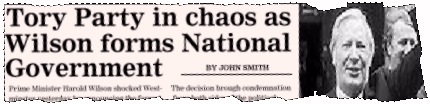
Prime Minister Mr Harold Wilson shocked Westminster by announcing the formation of a national Government yesterday, with the support of rebel Conservative MPs. Several left wing Labour MPs have resigned from the Government in protest.
In the wake of the vote of no confidence on Tuesday evening, which the Government won with a majority of 24 after eleven Conservative MPs voted with the Government, the Conservative Party Chief Whip, Mr Humphrey Atkins, suspended the Conservative whip from the twelve rebels, including well-respected members such as Mr Geoffrey Rippon, Mr Peter Walker and the former Party leader Mr Edward Heath. A short statement from Conservative Central Office said simply that “having voted against the Conservative Party on a matter of confidence there was no alternative than to suspend the Conservative whip.”
While the political world was still reeling from the stock decision of the Conservative MPs to back the Government, Mr Wilson trumped the surprise with an even more unexpected announcement. The eleven Conservative MPs and Mr Quintin Hogg, who left the Conservative Party two years ago in protest at Mr Powell's leadership, are to sit on the Government benches as National Conservatives. There will be seats in the cabinet for Mr Edward Heath, as Deputy Prime Minister, and Mr Geoffrey Rippon at Trade. The other Conservative MPs to have crossed the floor are Mr Hugh Dykes, Mr Ian Gilmour, Sir Anthony Meyer, Mr Francis Pym, Mr Norman St.John-Stevas, Mr Anthony Kershaw, Mr Nigel Fisher and Mr Mark Carlisle.
In a joint statement yesterday Mr Wilson and Mr Heath said that the national Government was vital in the face of the economic crisis facing the United Kingdom. Mr Quintin Hogg said yesterday that “the United Kingdom needs strong responsible Government at this time. It would be national suicide for us to elect a bunch of racist headbangers at a time when the country needs a steady and sensible hand. Sadly that is what my party seems to have become.”
The decision brought condemnation from both sides of the political spectrum. Mr Tony Benn and Mr Michael Foot have both resigned from the cabinet, having refused to serve alongside Conservative ministers. Mr Ian Mikardo condemned the move asking, “how can we ever hope to achieve socialism with a phalanx of failed Tories on the front bench.” He also accused Mr Wilson of becoming “another Ramsey MacDonald.” Mr McDonald, a former Labour Prime Minister, is still a hate figure for much of the Labour movement for heading the National Government in the 1930s with support from the Conservative Party.
Senior Conservative Party figures also condemned the move. Shadow Chancellor, Sir Keith Joseph, mocked the “government of national unity” as “a government of national failure.” His opinion was echoed by Conservative Vice-Chairman, Mr Norman Tebbit, who described Mr Heath's decision as “the last grasp for power by a bitter and rejected old man.”
From “Things Fall Apart” by Ian Gilmour (Phoenix, 1986)
When the split finally came it came suddenly, and was portrayed in the media as a great shock. However, for those within the party the signs of a party on the verge of splitting had been there for a long time. Quintin Hogg, of course, had left the party long before and waited patiently in the wilderness for others to join him. Edward Heath had also been a de facto independent since Powell became leader. While it would have been too embarrassing for both sides for Heath to have left the party — it would certainly have been wrongly characterised as sulking were Heath to have jumped ship — he regularly spoke out against Powell and Joseph's more right wing excesses and was unconstrained by the Conservative whips. The other National Conservatives included talented ministers who had been unable to serve under Powell, such as Geoffrey Rippon and Peter Walker, who had both been unfairly dismissed for voting in favour of Europe, an issue where it would have been infinitely more intelligent to allow a free vote than to waste talented ministers in the name of dogma. There were also several young MPs who had entered Parliament while the Conservative Party was promoting true One Nation Toryism and were now revolted by the vulgar racism and greed that it was espousing under Powell, and it was perhaps MPs such as these who were in bravest in their decision.
Many on the right have sought to characterise the decision of the National Conservatives to back the Government as one born of bitterness, or a final grasp at power by those rejected by the electorate. The honest truth of the matter though was that it was concern for the country that drove us. At the time we had received no guarantees from the Labour Government and it seemed likely that our decision would terminate our political careers. It was certainly not an act inspired by personal gain, rather the acceptance that the country did face a crisis and that it would be disastrous to risk an election that could put a fanatical and extreme Conservative government into power. The view that I held, and that came across from my other colleagues in discussions at the time, was that, much as we loved the Conservative Party of old, it was our duty do all we could to prevent a Powellite government.
From “Difficult Times. Diaries 1974-1980.” by Tony Benn (Arrow, 1984)

4 June 1974. The European Communities Act became law today under the Parliament Act 1911. Harold announced our entry into the Common Market from the 1st January in a statement to the House. Much through I disagree with the House of Lords, I find his behaviour over the Act to be disgraceful. I spoke to the demonstration in Trafalgar Square at 11 o'clock. There were about twenty or thirty thousand people and it was all very good natured. I met lots of dyed in the wool Conservatives who cheered me and shook my hand despite the Daily Mail spending its time trying to convince them that I am the epitome of evil.
Ian Mikardo and another ten of us on the left went ahead with their press conference announcing they would no longer support the Labour/Conservative coalition. I was tempted to join with them, but was talked down by Eric Heffer who said I would have to remain within the mainstream party or there would be no standard bearer for the left in the inevitable post-election leadership election. I feel very ashamed of myself, but went along with his advice.
The press conference was chaotic, the media were one hundred percent against Ian and the others, almost accusing them of treachery. The fact is of course that they were elected on a platform of supporting a socialist government, not to back Ted Heath as deputy Prime Minister.
From the Daily Telegraph, 6th June 1974
Barring another shock like that of last month, the short lived Labour/National Conservative Government seems certain to fall tonight after two more unions voted to go on strike, and the Conservative party tabled a further motion of no confidence. The eleven rebel Labour MPs, led by Mr Ian Mikardo, have announced that they are not willing to support the coalition and it seems likely that the motion will be carried.
Should the Government lose the vote tonight, as seems likely, Mr Wilson will have to go to the Palace and tender his resignation to the Queen, and will tomorrow announce the date of the General Election. This is expected to be almost immediate, as both parties are already on an election footing, and experts predict that the election will be called on the first possible date, Thursday 4th July.