Esperanto Music History
In-depth histories of Esperanto music groups and albums by Thomas Preece
The First Song in Esperanto
Today I am looking at the question of what was the first song written in Esperanto? While this sounds very simple, there are actually a few different possible answers, depending on how you interpret the question. Because the earliest Esperanto songs were originally written as poems and later set to music, we’ll look at three categories: the earliest original Esperanto text that later became a song; the earliest melody composed for an original Esperanto text; and the earliest Esperanto song originally written as a song with both melody and lyrics, as opposed to a poem that was later set to music.
Update: Since this article was first published, some even earlier songs have been found in the category of “The First Song Written as a Song”. I’ve added details below.
The Earliest Text
The first publication of Esperanto, known as the Unua Libro, was released in 1887. This book explains Zamenhof’s reasons for creating the language and contains a basic grammar and vocabulary, together with a few short sample texts: translations of the Lord’s Prayer, the beginning of the book of Genesis and Mir träumte von einem Königskind by Heinrich Heine; and two original poems, Mia Penso and Ho, Mia Kor’.
Although Mia Penso was originally written in pra-Esperanto some years previously and then updated into the modern language for publication, Ho, Mia Kor’ was written directly in modern Esperanto. As such, Ho, Mia Kor’ is generally considered to be the earliest original literary work in Esperanto.
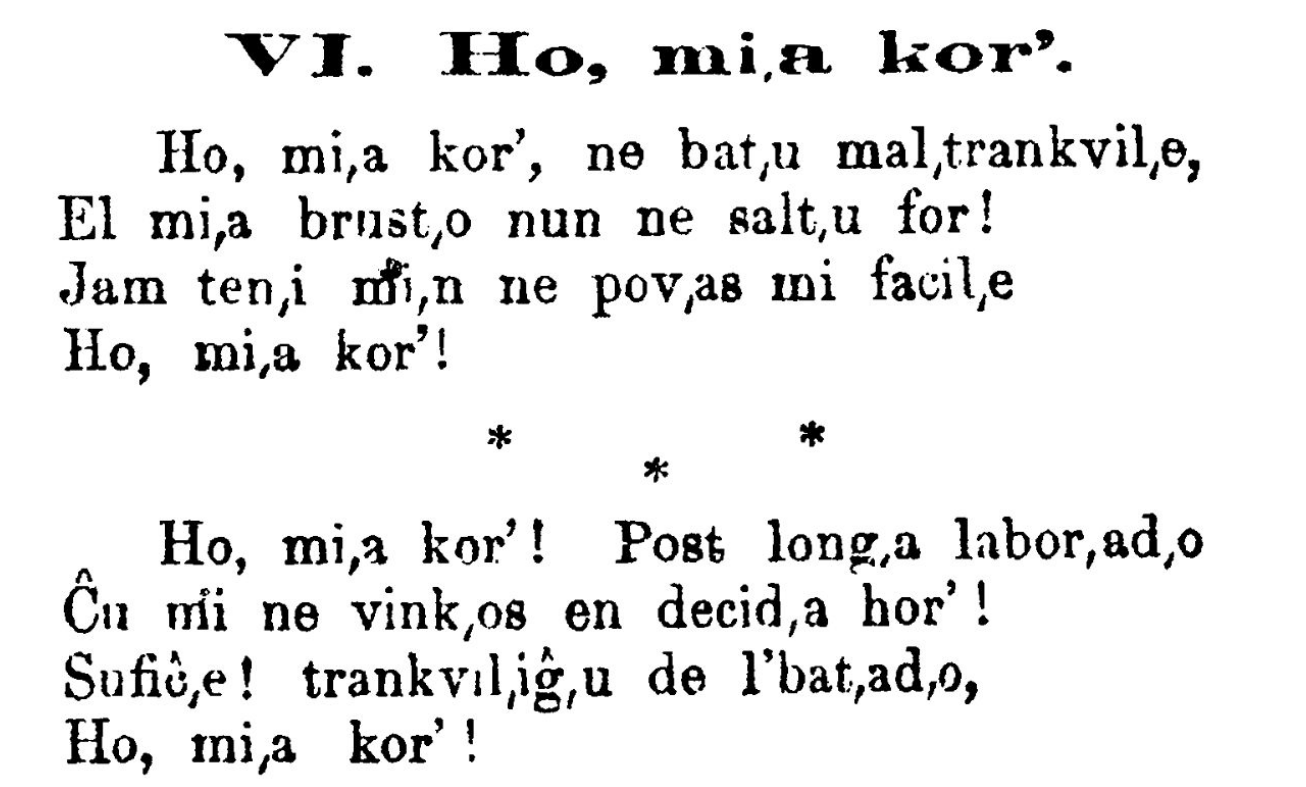
This image shows how the poem was originally presented in the Unua Libro. At this stage of the language’s development, Zamenhof still suggested the use of commas or apostrophes between all the components of a word, and the verb “venki” (to conquer) was still “vinki”. Modern versions of the poem omit the mid-word punctuation and use the modern spelling.
Ho, Mia Kor’ is one of the most frequently adapted poems in Esperanto music, and has been set to a variety of different melodies. Here are just a few examples:
The First Text to be Sung
While I wasn’t able to find a definitive date for the earliest sung version of Ho, Mia Kor’, it is notably absent from every early Esperanto songbook that I have access to. It’s likely, therefore, that the first musical version of it is as late as the second half of the 20th century. By contrast, the earliest musical setting of La Espero is from 1891.
As a poem, La Espero was written by Zamenhof and first published in 1890 in the Plena Lernolibro de la Tutmonda Lingvo Esperanto por Rusoj (“Complete Textbook of the Worldwide Language Esperanto for Russians”). The text appears to have caught the imagination of the early Esperanto speakers, as it was almost immediately turned into a song. The 1891 melody was composed by the Swedish civil engineer, Army officer and politician Claes Adelsköld, and is the earliest known formally published musical composition with Esperanto lyrics.
As Adelsköld’s version is practically unknown these days, I collaborated with the Esperanto singer Ralph Glomp to make a recording of it. Ralph’s recording demonstrates that it is probably a melody more suited to solo interpretation than to communal singing - which no doubt is a big part of why it never saw widespread use.
The Esperanto Wikipedia lists at least 21 different melodies for La Espero that have been composed over the years. The most well-known is that by Félicien Menu de Ménil, published in 1909. This melody was much more popular and widely accepted than Adelsköld’s: by the 1920s, Esperanto songbooks presented it simply as “La Espero”, without any further comment or acknowledgement that there were also any other melodies for the same text. La Espero with de Ménil’s melody was also the subject of many of the earliest Esperanto records - including a recording made in 1926 by the band of the Honourable Artillery Company and the singer Gladys Cosmetto:
The fact that the first recording of La Espero would be by a military band is somewhat ironic, but perhaps unsurprising considering the style of the music. Indeed, the use of a triumphal march as a melody was not without controversy when de Ménil’s version was first published, as it was felt to be an inappropriate style of music for an essentially pacifist anthem. Others objected to the use of the word himno (“anthem”) to describe the song, and the use of religious expressions such as sankta (“holy” or “sacred”) and eterna ben’ (“eternal blessing”) in what was supposed to be a neutral text. But nonetheless, La Espero with de Ménil’s tune was unofficially but universally adopted as the anthem of the Esperanto movement.
The First Song Written as a Song
As most early Esperanto songs were either translations of folk songs, or new lyrics set to existing melodies, or melodies composed for existing poems, the concept of a song that was written with both Esperanto lyrics and an original melody at the same time arrives surprisingly late.
Update - 29th August 2025
While I previously described Lulkanto from the 1964 LP Ni Kantu en Esperanto as “probably the first Esperanto song to be written in this way”, Miguel Bento has pointed out the existence of at least two earlier such songs.
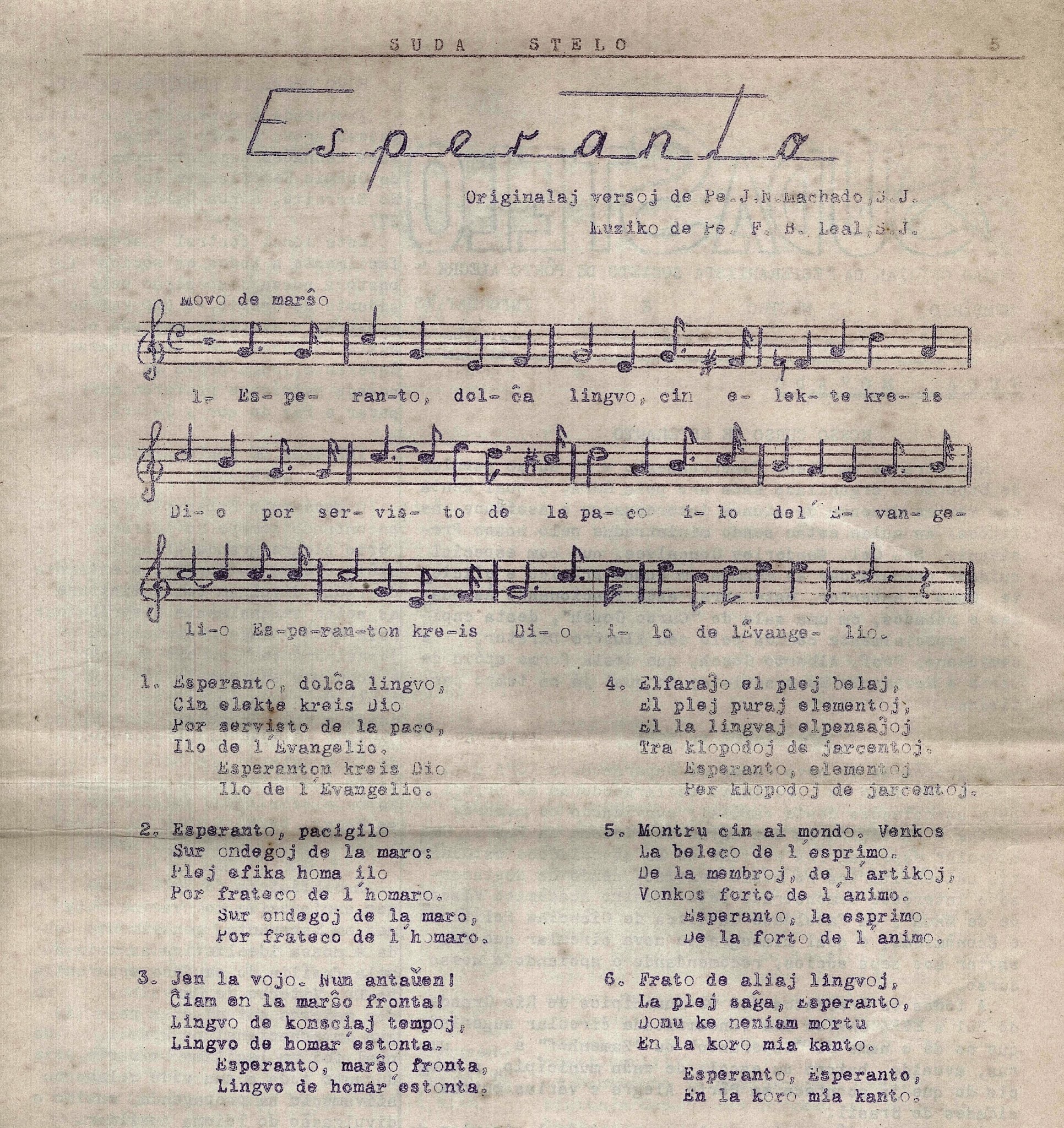
Esperanto, with lyrics by J N Machado and music by F B Leal, was published in the magazine Suda Stelo in May-June 1948. The sheet music, reproduced below from the Brazila Muziko website, shows that the lyrics are “original”, and so as of this update it is the earliest known Esperanto song with original lyrics written at the same time as the melody (but see below).
Miguel also points out the Himno de la XIII Brazila Kongreso de Esperanto. While this is a few years later, from 1952, apparently the Brazila Kongreso in this era had a tradition of composing a new anthem every year. While it’s unclear when this tradition began, it’s plausible that there are earlier anthems than this one, and potentially even earlier than 1948.
Update - 9th November 2025
I’ve recently been looking through some old Esperanto magazines, and found the following sheet music for Leono Estas Best’ in the May 1933 issue of The British Esperantist:
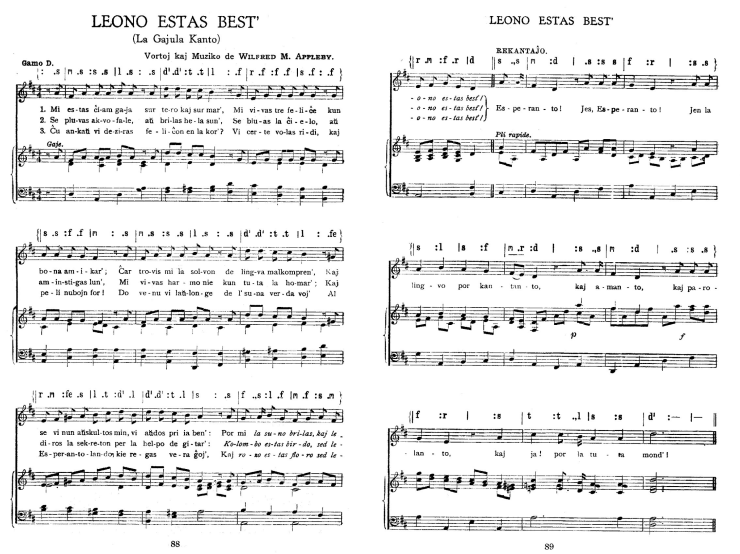
This song, with melody and lyrics by Wilfred M Appleby, is by no means a new discovery - it appears in KantarViki, and seems to have been published as sheet music in 1950. However, its appearance in The British Esperantist shows that it was actually written much earlier than that, and as the lyrics refer to Esperanto as “the language for singing”, it seems reasonable to conclude that they were written specifically as a song and not originally as a poem. So for now it is the earliest known fully original Esperanto song.
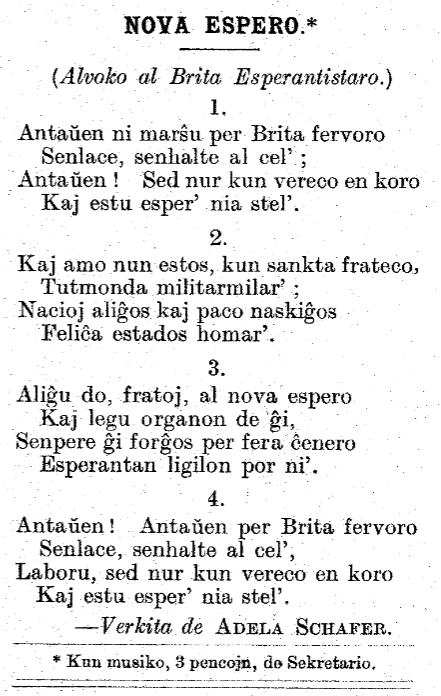
Update - 13th November 2025: I’ve found a new possibility for the earliest original Esperanto song, in the form of these lyrics for Nova Espero by Adela Schafer, published in issue 7 of The British Esperantist, July 1905. Although only the lyrics were published in the magazine, a footnote shows that the music could be purchased for 3 pence.
Song lyrics, usually without the accompanying music, were a regular feature in early issues of The British Esperantist, however they invariably mention the name of a well-known melody to which the lyrics were to be sung. The fact that this one mentions that the music can be purchased strongly suggests that it was probably an original melody.
Unfortunately I’ve not been able to source a copy of the sheet music for Nova Espero, so I can’t be certain as to whether it was original or an adaptation of an existing tune. If anyone has any further information, please do leave a comment below or send me a message!
Lulkanto, however, is still the earliest recording of an original Esperanto song, and is probably also the earliest song with an original Esperanto text that isn’t about Esperanto itself. With lyrics by Vilma Eichholz and music by Frans Jahger, the singer, it is specifically mentioned in the album’s liner notes as being completely original, and is, as the name suggests, a simple lullaby. As far I am aware, all other Esperanto songs prior to this were either translations or settings of existing poems or had lyrics about Esperanto and the Esperanto movement - I include Ho, Mia Kor’ in both of the last two categories, as it is by Zamenhof.
Indeed, original songs remained uncommon in Esperanto right up until the start of the rock music movement in the 1980s. This perhaps reflects the viewpoint of the early Esperanto movement that Esperanto was supposed to be a bridge language between cultures, rather than having a significant culture of its own: the point of Esperanto songs was seen as a way to learn and experience the music of other cultures. It’s probably no coincidence that original Esperanto music didn’t really take off until after the Rauma Manifesto of 1980, which was the first declaration of the Esperanto community’s own culture having worth for its own sake.
The First Song in Pra-Esperanto
Although modern Esperanto was first published in 1887, it wasn’t the first version of the language that Zamenhof created. As early as 1878, he had a version of his lingwe universala that he considered complete. In a letter to Nikolai Borovko, written in the 1890s, Zamenhof describes the early history of the language:
"On the 5th of December 1878 we all solemnly celebrated the sanctification of the language together. During this celebration, there were speeches in the new language, and we enthusiastically sang the anthem with the opening words:
Malamikete de las nacjes
Kadó, kadó, jam temp' está!
La tot' homoze in familje
Konunigare so debá."
This letter clearly demonstrates that Zamenhof considered songs to be an important aspect of his new language right from the beginning. Although the rest of the anthem’s lyrics are lost, along with all of the music, this is undoubtedly the earliest song in Zamenhof-lingvo.
In 2012, the singer and rapper Eterne Rima released his interpretation of this anthem as part of his Abatejo project:
Update: Miguel Bento also points out this song version of Lá Dinko, the original pra-Esperanto version of Mia Penso, published in 1886. While this clearly post-dates Malamikete de las nacjes, it is interesting to read the pra-Esperanto text and to see how it changed into modern Esperanto. It also further reinforces the idea that Zamenhof considered songs to be an important aspect of his language from the very beginning.
One of the challenges with trying to find the earliest example of anything is that the answers are always somewhat provisional. It’s entirely possible that there are yet earlier songs to be found - most probably in the category of “the first song written as a song”. If you know of any, please do get in touch or let me know in the comments below!
Comments
Contact
Copyright © 2025 Thomas Preece