Save the Dust Jackets!
Other than having thousands of books, I'm not really a book collector. In other words, I don't generally spend more than I must to get something decent (because I do care about at least "enjoyable to read" condition and the books I read tend to be in the same condition after I'm done that they were in before I started) and I don't buy things I intend to seal in an argon case or whatever, but just stuff I intend to read (if only some day). Still, I recently learned that dust jackets (which I always thought were somewhat important) are _really_ important, at least in terms of collector value. That, coupled with getting some books in a series with protected dust jackets and some without (as well as some with none at all, unfortunately) and wanting to have them all protected, led to my buying a couple of small packs of polyester dust jacket covers on Amazon to experiment with. Then I got a little smarter and signed up with brodart.com to order larger packs directly which costs more in absolute dollars but is far cheaper per book cover. Creating an account was relatively noninvasive: just give them an email address and choose a password. Then, obviously, if you want to get what you've ordered, you'll need to provide your name and address. The one problem is that, at least at the time I ordered (a couple-three months ago), there was an automatic shipping charge of $10.95 which was about a third of the cost of my total order. But if you wanted to make a bigger order, it might be the same or not much more and would be a proportionally better deal.
I was a little nervous about taking a part of a book that was molded to fit and mashing it flat and possibly screwing it up but it turns out you can be pretty vigorous with it without any problem and the jacket with its new jacket-jacket basically returns to its previous state. The most helpful "how to" video of a few that I looked at was
However, I found that the suggestion about flattening out the Brodart cover was a good one, but slightly overkill, and had better luck just putting some more books behind the cover, opening the paper up over them, and just creasing it lightly to insure a ninety-degree angle. That let me get the dust jacket to fit tightly without distorting the cover. I also got by with using my thumbnail rather than a special tool such as the bone folder, though I bet the tool would be better.
I also went with the "Just-A-Fold III Archival Book Jacket Covers" though I went with the sheets rather than the rolls because, while more per cover and not cut-to-fit, the packs cost fewer dollars than the rolls. Still, in retrospect, I probably should have spent more and gotten the rolls. That affects the horizontal length but I would make a note about the vertical length: the Amazon page (and I think Brodart, itself) claims that a given size will fit a book "several inches" smaller and this is technically true but I found that using a ten-inch cover on, say, a nine-inch book creates a sort of puffy, padded feel vs. using a nine-inch on a nine-inch. I can't figure out the logic of why this should be so unless creating your own fold is simply not as sharp as using the perforated "[ad]just-a-fold[s]" but it does seem to make a slight difference. So I'd say you could certainly use a ten on a nine or the like in a pinch but I'd prefer to get the right size.
Finally, I would say to watch out for the things that aren't "archival" because (a) the plastic (polyester or polypropylene) may not be of lasting, safe quality and (b) more likely, the printing on the paper of some may leach into the jacket. Conversely, if people who know more about this stuff than I do could tell me, maybe it's just wasted money if the "non-archival" ones are good enough, because the archival ones are a little bit more. And, speaking of the paper, some collectors would argue that there shouldn't be any paper at all, as this may affect the dust jacket's fit, though it does provide more support if you're trying to preserve a damaged jacket rather than keep a perfect one perfect. Another downside of the paper is that, somehow, a chipped dust jacket with the spine showing looks more "natural" than the chipped areas showing white paper covering the spine but, as I say, without the paper, the covers feel pretty flimsy.
Anyway, it's not much, but it's what little I learned from this experience and I hope it's helpful (or at least has some interest) to somebody and maybe inspires more knowledgeable people to improve this post.
---
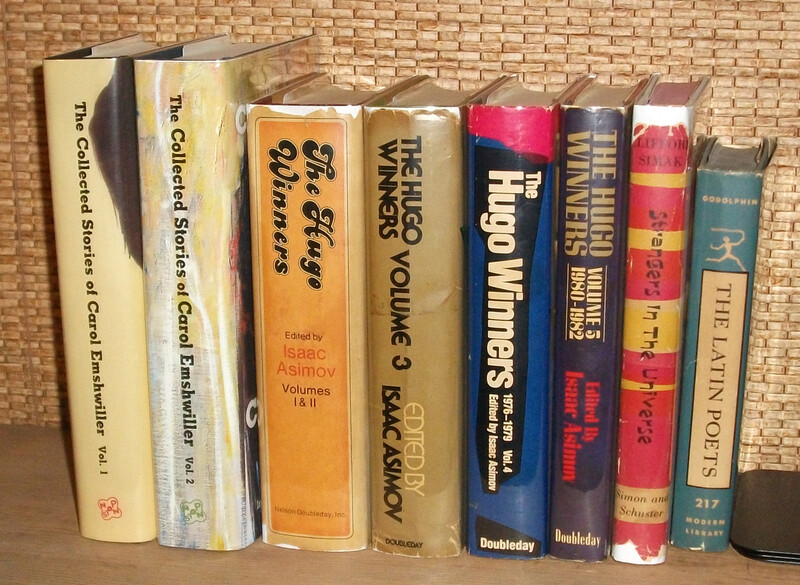
Though there's ideally not much to see, here's a pic of some of the ones I did. First comes a two-volume set I want to keep as perfect as I can (if you can call anything rife with typos "perfect"). Next a set in variable sort of "standard poor" condition. Then a truly bad one (the Simak) where I really enjoy the feeling of being able to handle the book without fear of the jacket disintegrating when I do so. The last one (_Latin Poets_) is a bit of an oddity because (a) old Modern Library books almost never have their jackets, (b) those jackets have a book list printed on the inside which the paper of the Brodart cover would, well, cover, and (c) they're very small. So I was able to detach the paper from the plastic of one of the sheets, cut the plastic to fit better and cover most of the back of the jacket, and crease it hard with my thumbnail, and it seems to work well.
---
Page created: 2023-04-30
Last changed: 2023-04-30