Point WTC7-6: The Fraudulent NIST Claim That There Was No Steel Recovered from Building WTC 7 for Analysis
Introduction
The mysterious collapse of World Trade Center 7 – a 47-story steel-framed skyscraper adjacent to the Twin Towers that fell suddenly into its own footprint at 5:21 PM on September 11 – was officially claimed to have been caused by fire alone.
Given the fact that all previous collapses of steel-framed buildings involved controlled demolitions using explosives, the unprecedented sudden collapse of WTC 7 should have precipitated an intensive investigation to determine exactly what happened, so that, if the collapse was indeed brought about by fire alone, such a disaster could be prevented from happening again.
A crucial element in such an investigation would be an examination of recovered steel from the collapse, to see if the quality of the steel had been inadequate, or whether, as some suspected, WTC 7 had been brought down with the use of explosives. It would also be crucial for the report of the investigation to be peer-reviewed.
The Official Account
No steel from WTC 7 was recovered from the collapse site, as NIST reports have repeatedly pointed out. [1]
Just as there was no reference to recovered WTC 7 steel in NIST’s Final Report on the Collapse of World Trade Center Building 7 (2008), [2] there was also no reference to the building or recovered steel in The 9/11 Commission Report (2004). [3]
Because no steel from WTC 7 was recovered, it was impossible to carry out any metallography. [4]
Accordingly, it was impossible for NIST to make any statements about the quality of WTC 7’s steel in its investigations. [5]
NIST has been able to describe the steel only on the basis of construction-related documents. [6]
The Best Evidence
I. There is ample physical evidence refuting NIST’s claim that no steel was recovered from WTC 7:
- Early evidence of WTC 7 steel recovery was reported in a 2001 letter to JOM [7] written by three professors from the Worcester Polytechnic Institute, entitled “An Initial Microstructural Analysis of A36 Steel WTC Building 7.” [8]
- In 2002, FEMA (the Federal Emergency Management Agency) published a report by the same professors describing the strange thinning and corrosion of World Trade Center steel. Sample 1 was a beam which “appeared to be from WTC7,” although “the exact location of this beam in the building was not known.” [9] When asked about this, a Senior Communications Officer for NIST said: “It was not possible to conclusively link” that steel sample to WTC 7. [10] But a statement like this from a communications officer cannot cast doubt on the evaluation of three scientists.
- That the steel appeared to have come from WTC 7 was confirmed by Professor Jonathan Barnett, lead author of the FEMA study, in a 2008 BBC documentary. [11]
- Appendix D of the same FEMA Report notes that “pieces that were searched for and inspected include … burnt pieces from WTC 7,” and includes a photo of a “WTC 7 W14 column tree with beams attached to two floors.” Another photo showed a “Seat connection in fire-damaged W14 column from WTC 7.” [12]
- It is clear from a 2005 damage study that NIST knew about the FEMA report, for it referred to “the steel from WTC7 (Sample 1 of Appendix C, FEMA/BPAT study).” [13]

- In 2012, a Freedom of Information Act (FOIA) request by researcher David Cole produced several photographs of John Gross examining the WTC 7 steel in a scrap yard. Gross was the Co-Project leader on NIST’s Structural Fire Response and Collapse Analysis. [14] He had responsibility to “determine and analyze the mechanical and metallurgical properties and quality of steel, weldments, and connections from steel recovered from WTC 1, 2, and 7.” [15]These photos were obtained by NIST FOIA #12-057, February 7, 2012, and are available in an online dataset.
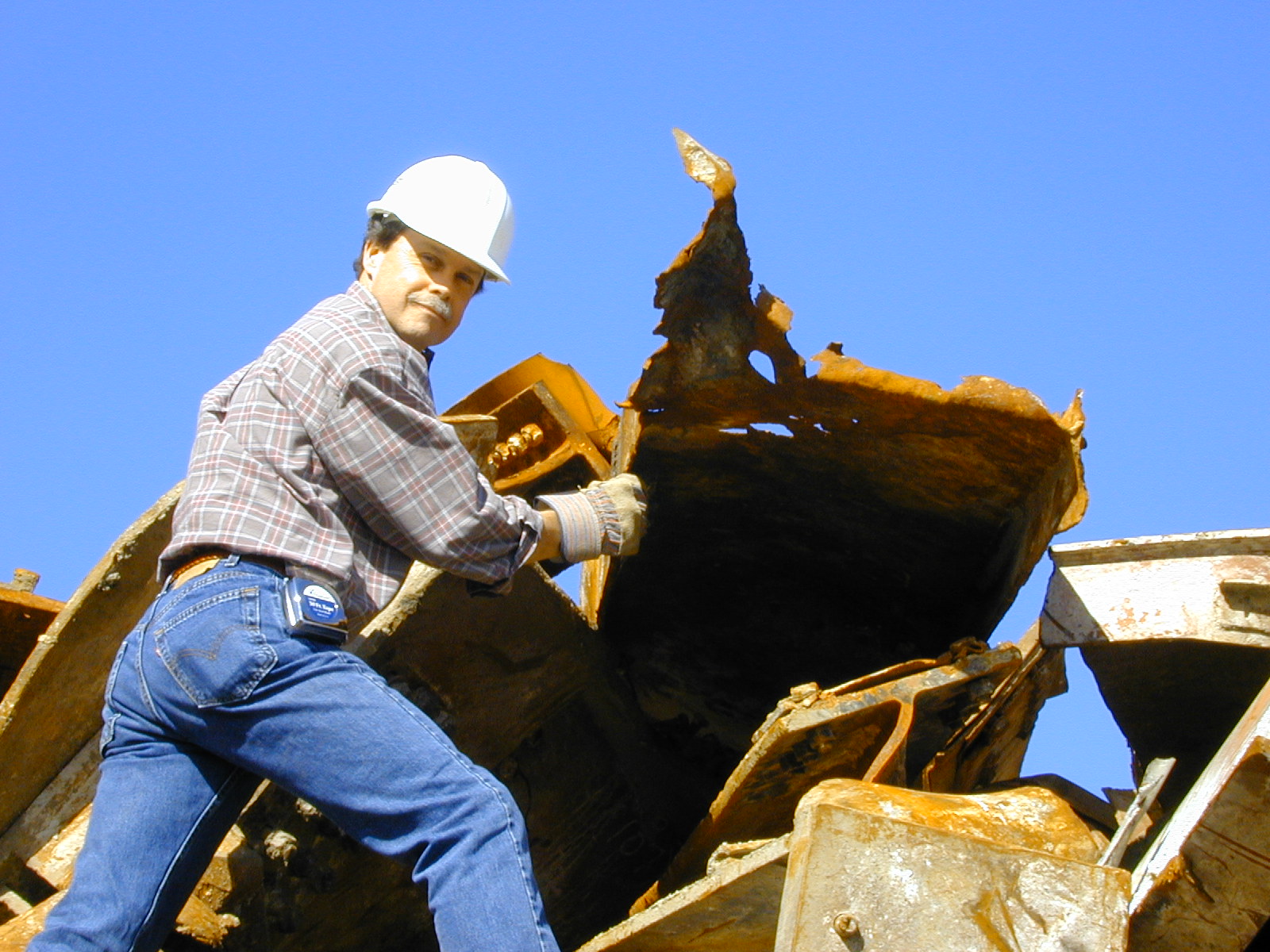
II. The examination of steel from WTC 7 was also covered in various news stories, including two from the New York Times and one from Worcester Polytechnic Institute:
* A New York Times article of November 2001 cited Dr. Jonathan Barnett of Worcester Polytechnic Institute as speaking about “steel members in the [WTC7] debris pile that appear to have been partly evaporated in extraordinarily high temperatures.” [18]
=>tt6.gmi (The presence of inexplicably intense heat is corroborated by Consensus Point TT-6: “The Claim That There Was No Molten Steel Or Iron in the WTC Buildings.” [19])
- A 2002 New York Times story noted: “Perhaps the deepest mystery uncovered in the investigation involves extremely thin bits of steel collected from the trade towers and from 7 World Trade Center, a 47-story high rise that also collapsed for unknown reasons. The steel apparently melted away, but no fire in any of the buildings was believed to be hot enough to melt steel outright.” [20]
- A story in the official publication of the Worcester Polytechnic Institute stated: “A one inch [steel] column has been reduced to half-inch thickness. Its edges – which are curled like a paper scroll – have been thinned to almost razor sharpness. Gaping holes – some larger than a silver dollar – let light shine through a formerly solid steel flange. This Swiss cheese appearance shocked all of the fire-wise professors, who expected to see distortion and bending – but not holes.” [21]
Conclusion
More than ample evidence shows that NIST’s claim – that no steel from WTC 7 was found – is false. By denying this evidence (which was even cited in one of NIST’s own reports [22]), it could claim that there was no evidence that the building had been brought down by explosives.
By denying the availability of WTC 7 steel, moreover, NIST positioned itself to explain the collapse by resorting to a computer simulation into which variables could be inserted at will – given the fact that there was to be no peer review [23] – and which has been shown to be false. [24]
References for Point WTC7-6
[1] The following statements were made in: NIST, Materials Science and Engineering Laboratory. NCSTAR 1-3,
- 1. “Although no steel was recovered from WTC 7, a 47-story building that also collapsed on September 11, properties for steel used in its construction were estimated based on literature and contemporaneous documents.” p. iii
- 2. The steel used in the construction of WTC 7 is described based solely on data from the literature, because no steel from the building was recovered. p. xxxvii
- 3. No steel was recovered from WTC 7; however, construction-related documents describe the structural steel as conventional 36 ksi, 42 ksi, and 50 ksi steels. p. xliv ibid.
- 4. Since no steel from WTC 7 was recovered from the site, the steel used in the construction of this building is described based on data from the literature of the period. p. 1.
- 5. Because NIST recovered no steel from WTC 7, it is not possible to make any statements about its quality. Ch. 7.7.2 Mechanical Properties of WTC 7 Steel, p. 114.
- 6. “No metallography could be carried out because no steel was recovered from WTC 7.” Ch. 7.7.3 Physical Properties of WTC 7 Steel, p. 115.
- 7. “Because NIST recovered no steel from WTC 7, it is not possible to make any statements about its quality,” page 273.
- 8. “These analyses were made only for steel from WTC 1 and WTC 2 as no steel was recovered from WTC 7,” p. 1.
- 9. “No steel from WTC 7 has been identified from the pieces of recovered WTC steel in NIST’s possession … Properties were estimated from available test data in the literature.” (Volume 1, Page 17)
[5] “Because NIST recovered no steel from WTC 7, it is not possible to make any statements about its quality.” Ch. 7.7.2 Mechanical Properties of WTC 7 Steel, p.114 in NIST, Materials Science and Engineering Laboratory.
1. “Although no steel was recovered from WTC 7, a 47-story building that also collapsed on September 11, properties for steel used in its construction were estimated based on literature and contemporaneous documents.”
p. iii
2. The steel used in the construction of WTC 7 is described based solely on data from the literature, because no steel from the building was recovered.
p. xxxvii
3. Since no steel from WTC 7 was recovered from the site, the steel used in the construction of this building is described based on data from the literature of the period.
p. 1.
[10] Michael E. Newman, Senior Communications Officer, NIST,
[11] Professor Jonathan Barnett, Fire Protection Engineer, Simpson Gumpertz & Heger, reported, “It came from a much larger beam … This was the size of steel that they used in the construction of Tower 7. They didn’t use this particular kind of steel in Tower 1 or Tower 2. So that’s why we know its pedigree. It was a surprise to me because it was so eroded and deformed and so we took it for analysis in the lab.”
The name of the WTC 7 photographs file is FEMA Photographs of WTC7_Beam_Photos_Scrap_Yard_OCT_2001.rar – RAR archive, unpacked size 11,280,860 bytes. David Cole wrote in an e-mail to Elizabeth Woodworth dated April 4, 2014 that “that while these [photos] were obtained from NIST, they are actually FEMA created records.”
[17] This Iwankiw (photographer) photo is taken from NIST FOIA Request #12-057, February 07, 2012. It’s file number is DSCN0397_Iwankiw, from file WTC7_Beam_Photos_Scrap_Yard_OCT_2001.rar. It may be found online, buried in
[23] In failing to seek peer-review from the scientific community, NIST had ignored the recommendation of Dr. James Quintiere, a professor of Fire Protection Engineering at the University of Maryland and a member of the advisory committee for NIST’s WTC project. In a lecture on the WTC investigations at the 2007 World Fire Safety Conference, Quintiere said: “I wish that there would be a peer review of this … . I think all the records that NIST has assembled should be archived. I would really like to see someone else take a look at what they’ve done; both structurally and from a fire point of view.” Speaking directly to a NIST representative, Quintiere said: “I found that throughout your whole investigation it was very difficult to get a clear answer. And when anyone went to your advisory panel meetings or hearings, where they were given five minutes to make a statement, they could never ask any questions. And with all the commentary that I put in, and I spent many hours writing things … I never received one formal reply.” Alan Miller,