Atoms
siiky
2023/07/28
2023/07/28
2023/07/28
science,chemistry
Shells and subshells
An atom's electrons don't fly around the nucleus in an orbit, like a satellite around a planet. Instead, electrons "exist", move, zip here and there, within a certain space around the nucleus. The space around the nucleus an electron spends most of its time in (e.g. 90% of the time) is called an "orbital" (NOT an "orbit").
Additionally, an atom's electrons don't all necessarily fit in the same orbital. Because of this, they're arranged in/distributed across shells (sort of like "levels"; see pic), called 1n, 2n, 3n, &c. Shells are generally filled with electrons from the lower to higher levels: first 1n, then 2n, then 3n, &c (there are exceptions, apparently?).
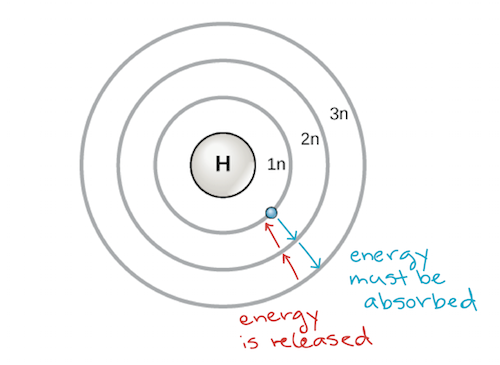
In turn, each shell is composed of one or more subshells (see pic):
- 1n is composed of 1s
- 2n is composed of 2s and 2p
- &c (i.e. I don't know more)
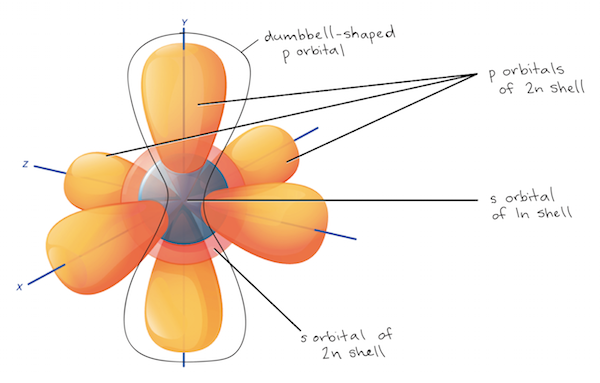
And subshells are composed of one or more orbitals (see pic):
- s subshells (1s, 2s, 3s, &c) are composed of a single orbital
- p subshells (2p, 3p, &c) are composed of 3 orbitals (2px, 2py, 2pz, &c)
- d subshells are composed of 5 orbitals
- f subshells are composed of 7 orbitals
Finally, each orbital may have at most 2 electrons, not more.
s orbitals have a spherical shape; and p orbitals have a dumbbell (or "hourglass") shape; (don't know about the other two).