Projects
These are a few of my most recent projects as of December 2024. If that is far in the past then it's possible I forgot to update this. You might also want to check out my website to see a more comprehensive (and potentially more up-to-date) list.
All projects listed here are open source; nearly everything of mine is, and the stuff that isn't (Petal Crash Online) will be open in the future.
Nova the Squirrel 2

Nova the Squirrel 2 is a SNES homebrew game I started in 2019 because I wanted a very exciting longterm project I could be very passionate about, that would help me cope with the enterprise Java job I had just started. And it sure has been longterm because it's been a good while. That's OK! But I do want to focus on it more throughout 2025.
It's a platformer game with puzzle elements in it, and it has Kirby-style ability copying, but I tried to put my own spin on the abilities; for instance there's a Conway's Life ability, and a burger ability with an exploding cheeseburger you can use as a temporary platform. I tried to especially put an emphasis on abilities that provide new movement options or that help allow for fun puzzles. You can move very fast and the game is supposed to be fun to go very fast in, carefully jumping and using abilities to weave through obstacles.
This game is a sequel to an earlier game I made for the NES which I feel was held back by me being inexperienced as well as the NES itself. I love drawing with more colors and getting to add shading and make something pretty, and the increased hardware limits give me more flexibility. The SNES is also just plainly my favorite console so that's a big plus.
I want to put a big emphasis on story this time, and the story would mainly take place on a separate hub world like in Drawn to Life, which itself is a big inspiration for me.
Maffi cyberspace game
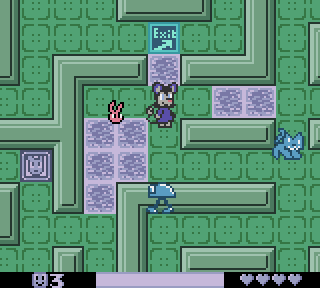
I still don't have a good catchy name for this yet. It's a maze game for Game Boy Color where you play as my SNES mouse character Maffi and explore randomly generated mazes in cyberspace, finding lost critters and guiding them out of the maze while defending yourself from enemies. You can attack using paint, which also lands on and marks the ground just like in Splatoon.
This is supposed to be a small game that isn't quite as longterm as my SNES platformer, and it has a much more focused design with a smaller scope. It was originally supposed to fit in 32 KiB, but I decided to make it bigger because I felt like it had a lot of potential and I didn't want to stop myself from just having fun making animations and a nice title screen and multiple tilesets.
This game works on the original Game Boy and has Super Game Boy enhancements, but I haven't drawn a fancy border yet. I did make the Super Game Boy palette something more interesting than just four shades of a single color.
Tilemap Town
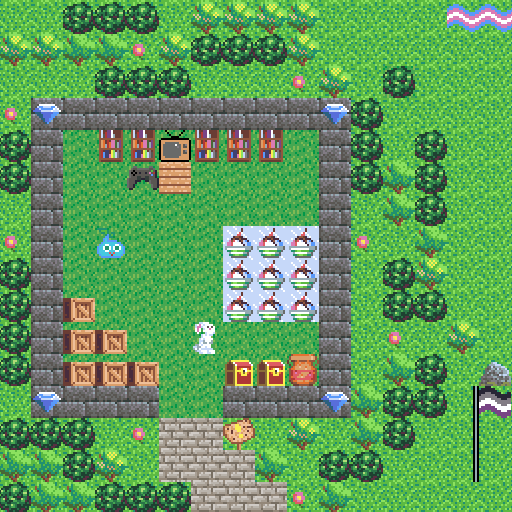
Tilemap Town is an online chat/roleplay platform anyone can host. It has an open, documented protocol, which is designed to be easy to extend while following the principle of progressive enhancement; a simple client is easy to make and is still meaningfully useful. It's built around WebSocket, JSON, PNG, and HTTP, and I imagine most languages have libraries available to work with those at this point.
It's a virtual world made of multiple sets of maps linked together, and the maps themselves are a 2D grid of tiles you can walk around and modify, placing down tiles to create whatever you like. Because of this, the world is a big collaborative project and there are all sorts of things different people have created over the years. You can use your own graphics for your own character and build with your own custom pixel art if you like too. Tilemap Town primarily takes inspiration from an old BYOND-specific genre called the "building game" or "icon game" that was one of th easiest thing to make on BYOND.
So far the clients available are a web client, a proof-of-concept client for the Nintendo 3DS, and a silly protocol gateway that tries to make the platform work through a MU* client, doing its best to show you the world with color codes and text approximations of the tiles. I was careful to make sure that the protocol is not tied to web browsers at all, and it uses BBCode for formatting which is nice and simple.
As far as roleplay features go, there are /me /ooc and /spoof commands, and you can easily switch between multiple different characters with their own appearances and descriptions. The map provides a helpful visual and you can see where characters are in relation to each other, and you can have characters react to the stuff you come across while exploring. This hopefully makes roleplaying less intimidating since just moving with the arrow keys and typing dialog is still participating in a meaningful way.
I also think it's just nice to have a platform where presence actually matters; on most modern chat platforms everyone is just always online, so it's hard to tell if someone is *actually* around, and people going further and hiding their online status doesn't help things. There is no chat history; you will only see stuff happening if you're present for it. And for me personally it helps me feel less lonely to have a representation of me on-screen next to a representation of my friends in some sort of world; that spatial element helps a lot.