Techrights
"Generative AI Bubble Has Begun to Pop", Nvidia Rides “Circular Financing... a Strategy That Hearkens Back to the Dot-com Crisis”
Posted by Roy Schestowitz on Dec 23, 2025
The US tech economy (not just the US but mostly the US) is a giant Ponzi scheme, establishing itself on money that does not actually exist (or debt). There is only one way this can end. The only question is, when?
Some sites [1] agree that slop bubbles are bursting (like "vibe coding", where reality inevitably shatters false expectations), that the lack of capital is alarming already [2], and it boils down to who goes down next [3] (assuming that "99% of AI Companies Won’t Survive After the Bubble Bursts"). Some speak of Nvidia (or "NVidia" or "NVIDIA") in relation to loans (Nvidia is a large participant in this Ponzi scheme, it ships GPUs that aren't even used just to fake "sales") and call it "a strategy that hearkens back to the dot-com crisis." [4,5]
Those who aren't wasting their time on slop and don't invest money in slop won't be impacted, except indirectly. For companies like Microsoft this may mean another 30,000+ layoffs next year. █
Related/contextual items from the news:
- 1
The Generative AI Bubble Has Begun to Pop
Generative AI has dominated the tech news over the last two years. More than 50% of venture capital funding goes to generative AI, which I distinguish from predictive AI, the older and, at one time, the more researched form of AI. Announcements and news from the big consulting firms and top business schools are also dominated by generative AI. The profit figures suggest that they are the most profitable organizations within AI outside of Nvidia.
- 2
Yes, the AI boom has a balance sheet problem
It is becoming one of the largest debt-funded infrastructure projects in modern history, and the strain is starting to show.
- 3
Wall Street Sees AI Bubble Coming and Is Betting on What Pops It
From a recent selloff in the shares of Nvidia Corp., to Oracle Corp.’s plunge after reporting mounting spending on AI, to souring sentiment around a network of companies exposed to OpenAI, signs of skepticism are increasing. Looking to 2026, the debate among investors is whether to rein in AI exposure ahead of a potential bubble popping or double down to capitalize on the game-changing technology.
- 4
Chipwrecked: Can Nvidia avoid the crash?
Another way lenders can try to reduce their risk is by asking for a high percentage of collateral relative to the loan. This is expressed as a loan-to-value ratio (LTV).
- 5
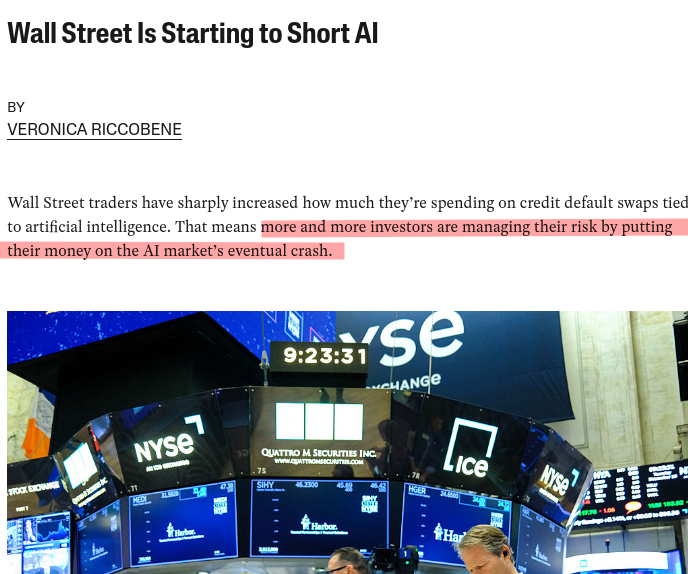
Wall Street Is Starting to Short AI
Also feeling the pain from bubble panic is Nvidia, a $4.3 trillion computer chip designer that counts among its customers AI behemoths like Oracle, Meta, and Amazon. Nvidia’s critics accuse the company of exacerbating the AI bubble through “circular financing,” in which it makes enormous investments in its own customers — a strategy that hearkens back to the dot-com crisis.